Culturally Responsive Dreamwork (CRD)
Culturally Responsive Dreamwork (CRD), developed by Alwin E. Wagener and J. Scott Young, is an approach to dreamwork in counseling and psychotherapy that places clients' cultural, spiritual, religious, and personal beliefs about dreams at the center of the process. CRD provides a flexible framework for exploring dreams without requiring counselors or clients to adopt a particular theory about the meaning or function of dreaming. The approach incorporates cultural humility, foundational counseling skills, and four areas of focus described through the SAFE framework: Sharing, Appreciating, Finding the Significance, and Editing.
Why a Culturally Responsive Dreamwork Model was Needed?
Culturally Responsive Dreamwork (CRD) was developed in response to the recognition that dreams are understood and experienced differently across cultures, and that approaches to dreamwork in counseling have often failed to adequately account for these differences. Many established approaches to dreamwork are grounded in particular theoretical explanations of why dreams occur and what they mean, with counselors using these explanations to guide their exploration of clients' dreams. Although these approaches can be useful, they can also introduce assumptions about dreaming that may not align with the beliefs and experiences of the client. Dreams may be understood as reflections of psychological processes, spiritual experiences, communications from ancestors, or experiences that have significance within particular cultural and religious traditions. When counselors approach dreamwork from a predetermined understanding of dreams, they risk overlooking what may be most significant to the client and imposing meanings that are inconsistent with the client's worldview.
This concern is particularly important because dreams can be deeply meaningful experiences, and clients' beliefs about dreaming can influence how they understand themselves, their relationships, and the events occurring in their lives. For some individuals, dreams may provide a means of understanding personal concerns or emotional experiences, while for others they may represent connections with family members, spiritual traditions, or sources of guidance. These understandings may influence not only how clients interpret their dreams but also whether they feel comfortable sharing them in counseling. A counselor who assumes that dreams are primarily expressions of unconscious conflicts, for example, may approach a dream quite differently from a client who understands the same experience through a spiritual or cultural framework. The resulting differences can affect the therapeutic relationship and limit the usefulness of dream exploration.
At the same time, dreamwork has often been treated as a specialized activity requiring training in a particular theoretical approach, which may contribute to its limited use in counseling. This is notable given that dreams can provide opportunities to explore experiences and concerns that are important to clients, and that counselors already possess many of the foundational skills needed to facilitate these discussions. Asking questions, exploring personal significance, reflecting experiences, and supporting clients in developing their own understandings are central activities in counseling and can also provide a foundation for working with dreams. What has been needed is an approach that allows counselors to engage in dream discussions without requiring adherence to a particular explanation of dream function or meaning.
CRD was developed to address these concerns by placing the client's cultural, spiritual, religious, and personal beliefs about dreams at the center of the dreamwork process. Drawing on principles of multicultural counseling and cultural humility, the approach recognizes that counselors do not need to determine the objective meaning or function of a dream to help clients explore its significance. Instead, counselors can work within the client's understanding of dreaming, remaining open to different possibilities while using their existing counseling skills to facilitate exploration. The SAFE framework provides four flexible areas of focus for these discussions: Sharing, Appreciating, Finding the Significance, and Editing. These areas allow counselors to engage with dreams in ways that are responsive to the client's beliefs, experiences, and therapeutic goals, while avoiding the imposition of meanings derived primarily from the counselor's theoretical perspective.
By providing a flexible approach to dreamwork that does not depend on a particular theory of dreaming, CRD offers a means of incorporating dreams into counseling while maintaining a commitment to culturally responsive practice. Its development reflects the understanding that the significance of a dream cannot be adequately considered apart from the individual who experienced it and the cultural and personal context in which it is understood.
Published Academic Journal Article
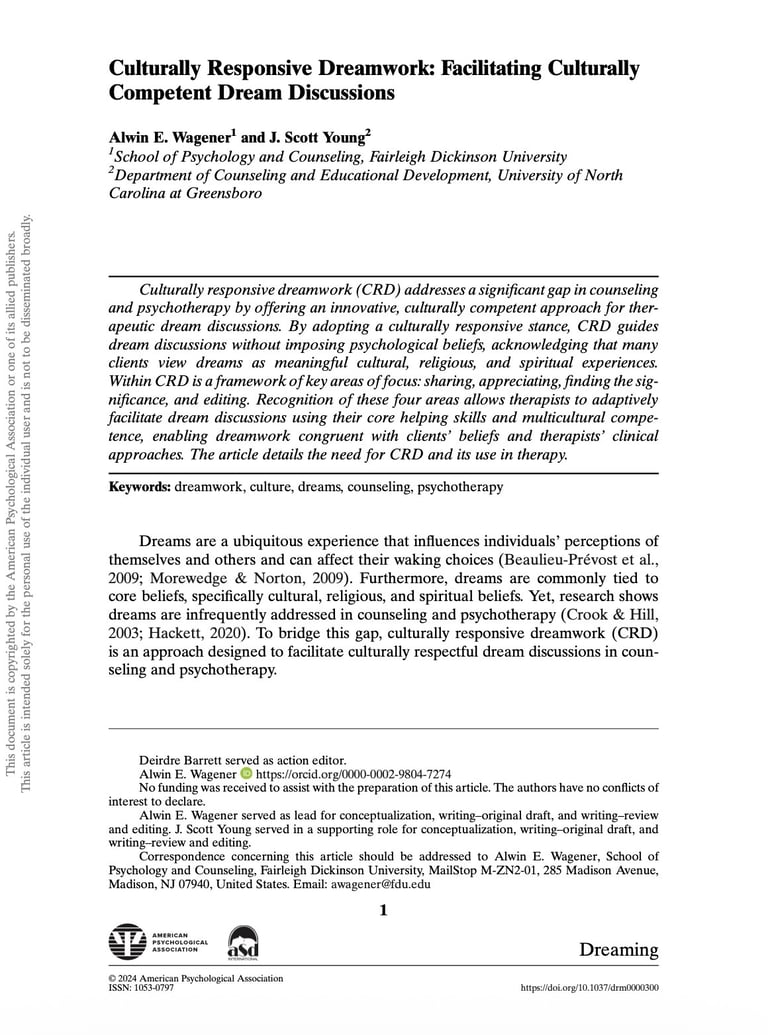
Wagener, A. E., & Young, J. S. (2025). Culturally responsive dreamwork: Facilitating culturally competent dream discussions. Dreaming, 35(2), 173-183. https://doi.org/10.1037/drm0000300
Presentations on Culturally Responsive Dreamwork
Wagener, A. E. (June 2026). Orienting Counselors and Psychotherapists to Assess Clients’ Dream Beliefs Before Dreamwork. Clinical Presentation. International Association for the Study of Dreams, International Conference, Ashland, Oregon.
Young, J. S. & Wagener, A. E. (October 2025). Exploring Dreams, Honoring Culture: Teaching Culturally Responsive Dreamwork in Counselor Education. Association for Counselor Education and Supervision, National Conference, Philadelphia.
Wagener, A. E. & Young, J. S. (June 2025). Culturally Competent Dream Discussions. International Association for the Study of Dreams, International Conference, Online.
Wagener, A. E. (September 2024). Dreamwork as Cultural Dialogue: Enriching Counseling Practice. One hour presentation. North Atlantic Region for Counselor Education and Supervision, Regional Conference, Atlantic City, New Jersey.
Wagener, A. E. (June 2024). Making Dreamwork Inclusive: Culturally Responsive Dreamwork. One hour workshop. International Association for the Study of Dreams, International Conference, Rolduc, Netherlands.
Wagener, A. E. & Young, J. S. (May 2024). Culturally Responsive Dreamwork- A Humanistic Approach to Increasing Inner Awareness. Association for Humanistic Counseling, National Conference, Online.
What is CRD?
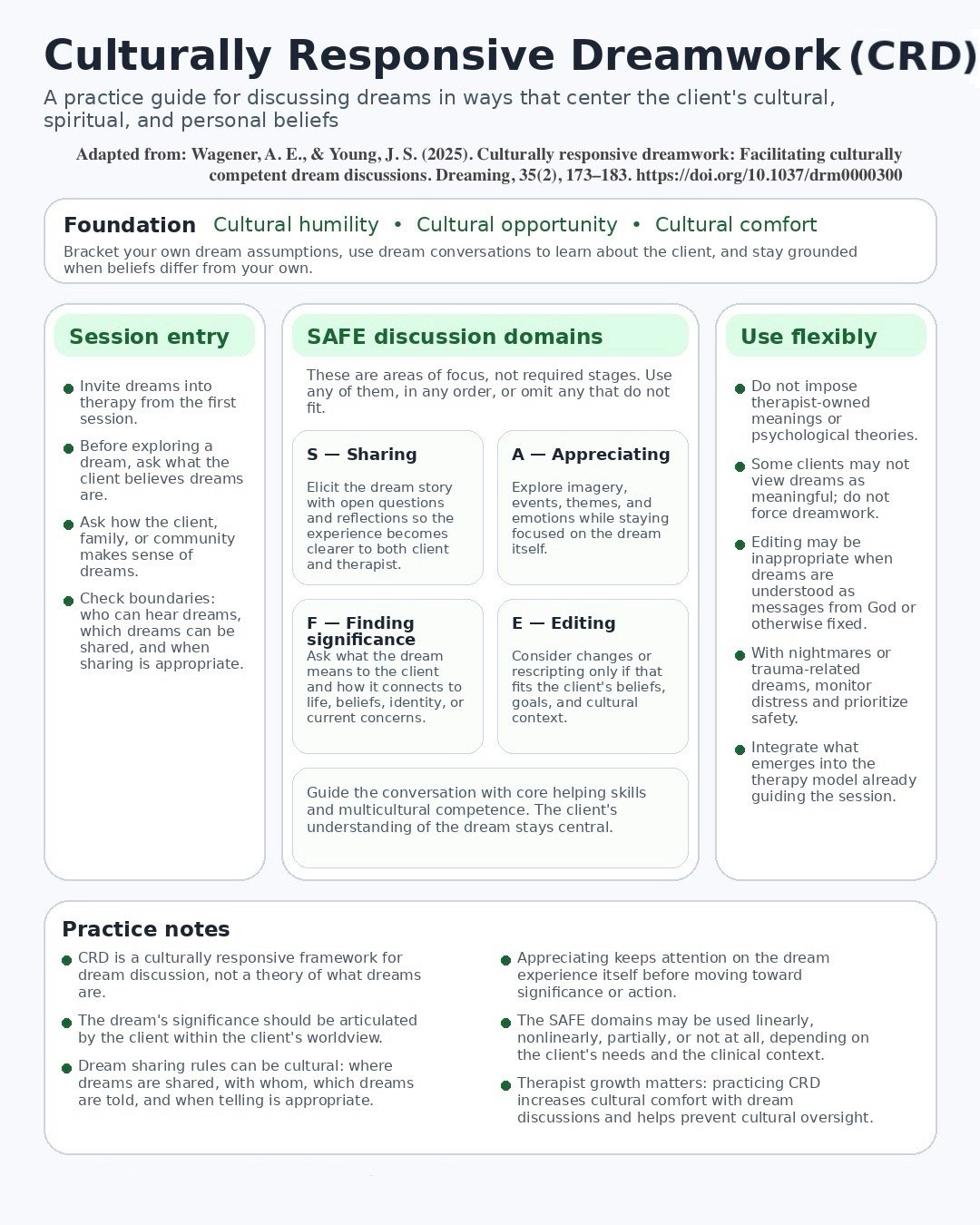
Culturally Responsive Dreamwork (CRD) focuses counselors on the cultural, religious, and spiritual dimension of dreaming and provides an approach and framework for counselors to center clients' dream beliefs in therapeutic dream discussions. It orients counselors to be culturally humble, look for opportunities to explore clients' cultural beliefs and experiences, and focuses clients on the need to be comfortable in discussing culture.
Invite Dreams and Discuss Dream Beliefs
CRD has counselors and psychotherapists ask clients to bring dreams into therapy and has them ask clients about their dream beliefs before discussing their dreams. Inviting dreams into therapy is a culturally responsive intervention that opens the door for clients who regard dreams as culturally, religiously, or spiritually significant. Asking about clients' dream beliefs invites clients' worldviews and belief systems into counseling and better enables counselors to center clients' beliefs in both dream discussions and across therapeutic interventions.
The SAFE Framework
CRD uses the SAFE framework to create awareness of four areas of focus that can be taken in dream discussions. These provide a flexible structure, in which no sequence is needed and not all areas need to be addressed. This flexibility allows counselors to respond to the needs, interests, and beliefs of each client.
Sharing: Providing clients with opportunities to describe their dreams. Counselors remain attentive to the client's comfort with sharing dreams and any cultural or personal beliefs that may influence the discussion.
Appreciating: Exploring the dream more fully, including its events, emotions, sensory experiences, and personally meaningful elements. The purpose is to develop a richer understanding of the dream experience.
Finding the Significance: Considering how the dream may relate to the client's life, beliefs, and concerns. The client's own dream beliefs and worldview should be centered in the exploration.
Editing: Exploring possible changes to a dream when doing so is appropriate and meaningful to the client. This may include imagining different responses or outcomes, particularly with distressing dreams, while recognizing that changing a dream may be inappropriate based on clients' dream beliefs.