
Embodied Cognition Theory of Dreaming (ECTD)
Published Academic Journal Articles:
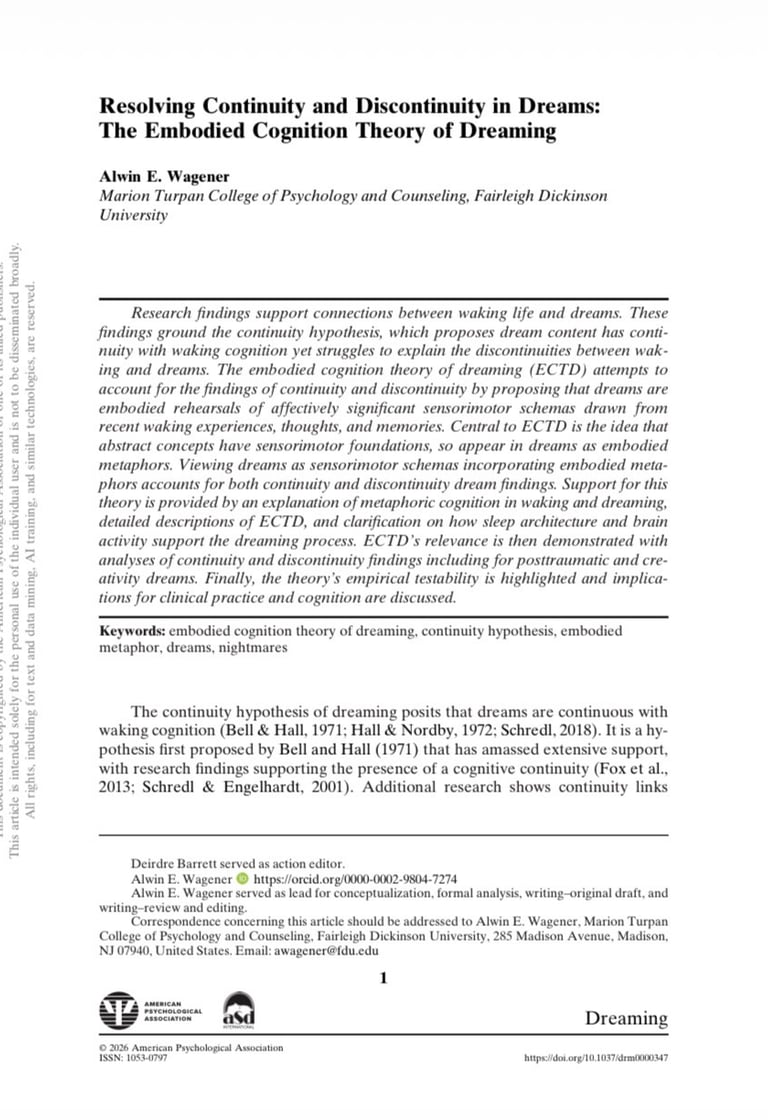
Wagener, A. E. (2026). Resolving continuity and discontinuity in dreams: The embodied cognition theory of dreaming. Dreaming. https://dx.doi.org/10.1037/drm000034
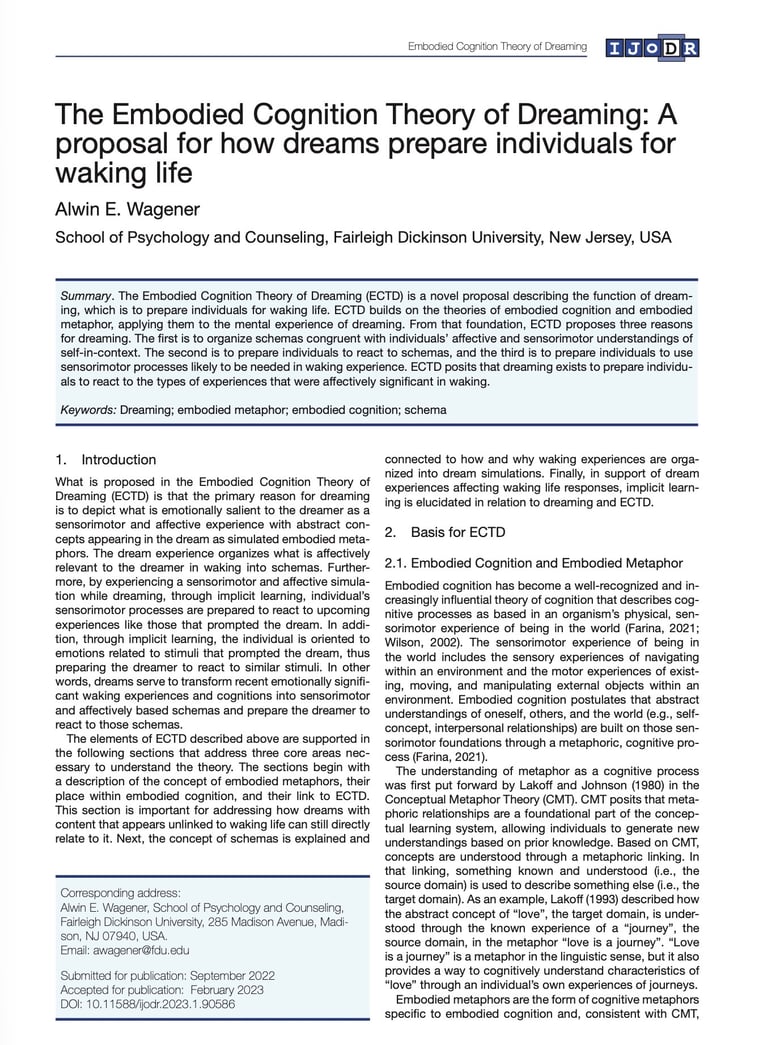
Wagener, A. E. (2023). The embodied cognition theory of dreaming: A proposal for how dreams prepare individuals for waking life. International Journal of Dream Research. 16(1). 35-39. https://doi.org/10.11588/ijodr.2023.1.90586
Brief Description of ECTD
ECTD is a new theory describing why we dream and how those dreams form. It is based on cognitive, psychology, and neuroscience research.
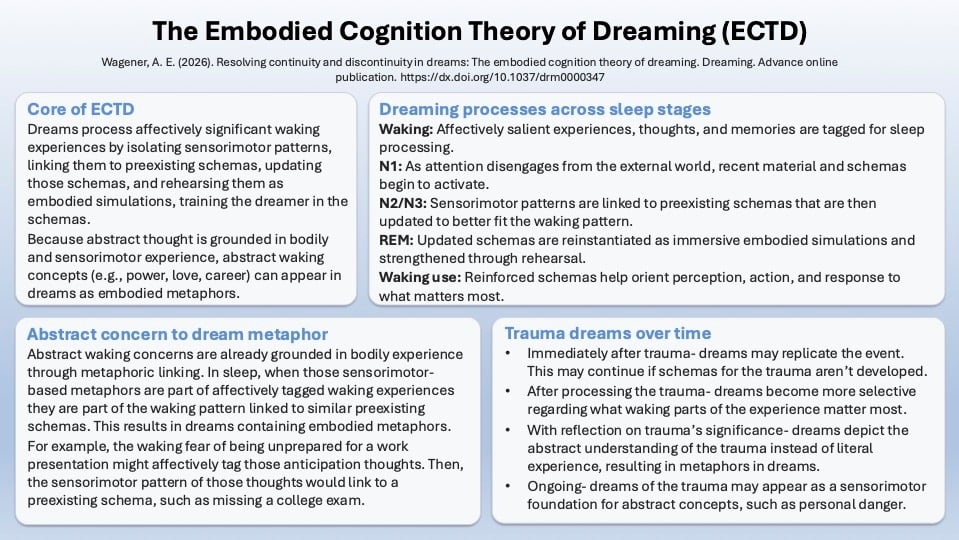
The core idea is that when we sleep, we process what was most emotionally significant to us during the day. We take the core physical patterns of those emotional experiences, link the physical patterns with preexisting patterns (i.e., schemas), update those preexisting patterns/schemas to match the waking experience, and then, in REM sleep, rehearse the patterns. That rehearsal is the embodied experience of dreaming, with less embodied dreams being the memories of the schemas as they are activated and updated in NREM sleep. The REM rehearsal/dreaming strengthens the neural connections of the pattern, training us in the patterns and making them useful for navigating our waking life.
In other words, when we sleep, we create maps for what matters and train ourselves in those maps, enabling us to recognize and respond to what matters more quickly.
A crucial component of ECTD is that when the emotionally tagged waking experience contains abstract concepts, such as power, loss, belonging, burden, career, meaning, and interpreted emotions, those abstract concepts appear as embodied metaphors. For instance the interpreted emotion of love might be portrayed through physical warmth (e.g., feel the heat between them) or being positioned as being physically close (e.g., feel close to her). There is a foundation for this explanation. Embodied cognition research shows that systems in the brain linked to physical experience are activated when abstract concepts are triggered.
The appearance of embodied metaphors in dreams helps to explain why dreams contain content unrealistic to waking, sometimes with fantastical elements. For instance a waking experience of having less power might lead to dreams of unrealistic size differences (e.g., giants), or a combination of personal traits such as curiosity and threat might lead to strange animals (a huge leopard, both inquisitive and dangerous).
What ECTD Explains
Why dreams often relate to waking life?
They depict the physical patterns of recent, emotionally significant experiences, which may be events, memories, or anticipated events.
Why dreams often feel physically real?
The embodied rehearsal of the schemas train the dreamer in the patterns, and that training requires a realistic, embodied experience.
Why dreams can be realistic, fictional, strange, or fantastic?
The patterns/schemas relate to waking life but may be unrealistic or fantastic because of including embodied metaphors for abstract concepts. Also, the use of preexisting schemas may pull in material that feels different from waking experiences but captures the same patterns.
Why dreams are story-like?
Dreams portray physical patterns from waking. The nature of the patterns requires a sequential experiencing in dreams, which is what makes them story-like.
Why NREM and REM sleep may contribute differently to dream formation?
ECTD proposes NREM isolates affectively significant waking patterns and links them to preexisting schemas that are updated as needed to match the waking patterns. In REM sleep, the updated schemas are rehearsed to train the dreamer, strengthening the neural pathways supporting the schemas.
Why nightmares after trauma may begin as direct replays and later become more symbolic or schema-based?
Post-trauma dreaming may first involve the unsuccessful attempt to isolate core schemas, resulting in the entire experience being rehearsed. As understanding of the experience grows, schemas capturing the physical experience and abstract understanding of the experience are updated and rehearsed. As the waking remembrance of the emotionally intense experience lessens, the trauma experience is less frequently selected as the pattern to rehearse.
Why dreams are so easily forgotten?
Dreams are an implicit training process. The details don't matter, what matters is the rehearsal of the patterns contained within them. The neural activations underlying dreams train us in our updated maps of what matters, preparing us for waking.
Why dreams may benefit psychotherapy and counseling?
Dreams are based on what most affects us in waking, which is relevant to therapy, and dreams depict our understandings of what is affecting us. This means that dreams show how we perceive our relationships, what matters to us, and how we interpret concepts like acceptance, grief, and anger. All of which is important for addressing issues of growth, well-being, and mental health.
Clarifications
Dreams are not symbols:
ECTD rejects fixed symbolism and grounds dream content in embodied cognition. ECTD states that dreams rehearse updated sensorimotor schemas and embodied metaphors appear as the internal, foundational explanations of the abstract concepts in those schemas.
Metaphors are not created in dreams:
ECTD says abstract concepts already have sensorimotor foundations that become part of waking patterns processed in sleep.
ECTD does not say all dreaming is in REM:
REM sleep is where embodied dreaming occurs, but waking remembrance of waking patterns and schemas from NREM are also remembered and called dreams. NREM dreams lack the full embodied experience of REM dreaming, but since both REM and NREM dreams are memories of experiences, the differences may not always be obvious.
The same dream is not repeated throughout the night:
ECTD describes a process in which the full affectively significant waking experience is isolated and linked to preexisting schemas, but also components of the waking experience are linked. The combinations of updated preexisting schemas in whole and components lead to a variety of dreams being repeated throughout the night. Which period of REM sleep and its length, along with the affective significance of the updated preexisting schemas determines which schema/dream is experienced at which time throughout the night.
Using ECTD to reflect on your dreams
The following free tools are GPTs built in ChatGPT that are available to use with a free ChatGPT subscription. Pay attention to the privacy information in ChatGPT to determine if you are comfortable using the tools.
The first linked tool uses ECTD to guide a dream exploration process to reflect on how your dream might relate to waking events, concerns, and anticipations.
The second linked tool provides a quick analysis of a dream based on ECTD to prompt reflection on it. It is not as accurate as the one above but is a helpful quick dream reflection tool.
ECTD Dream Feedback
Linked Articles
Wagener, A. E. (2023). The embodied cognition theory of dreaming: A proposal for how dreams prepare individuals for waking life. International Journal of Dream Research. 16(1). 35-39. https://doi.org/10.11588/ijodr.2023.1.90586
Wagener, A. E. (2026). Resolving continuity and discontinuity in dreams: The embodied cognition theory of dreaming. Dreaming. Advance online publication. https://doi.org/10.1037/drm0000347
Articles citing the 2023 ECTD article, The Embodied Cognition Theory of Dreaming: A Proposal for How Dreams Prepare Individuals for Waking Life:
Boudrias, S., & Douville, J. (2025). Manifestations of emotional memories in written and visual dream reports recurrences. International Journal of Dream Research, 18(2), 222–233. https://doi.org/10.11588/ijodr.2025.2.110871
Chou, C. M., Shen, T. C., Shen, T. C., & Shen, C. H. (2026). Influencing factors of teachers’ AR-supported technology application teaching effectiveness: using structural equation modelling. Journal of Computers in Education, 13(1), 87-126.
Garver, N. (2026). Dreaming in Focus: Cognitive and Evolutionary Perspectives on the Functions and Mechanisms of Sleep Cognition. International Journal of Dream Research, 19(1), 72–78. https://doi.org/10.11588/ijodr.2026.1.112635
Jennings, J. L. (2025). Pilot demonstration of a dreamer-centered dream series methodology for enriched phenomenological data and improved testing of the Continuity and Embodied Cognition Theories of Dreaming. International Journal of Dream Research, 18(1), 47–58. https://doi.org/10.11588/ijodr.2025.1.107327
Maggiolini, A. (2025). The relevance of typical themes for dream interpretation. International Journal of Dream Research, 18(2), 192–200. https://doi.org/10.11588/ijodr.2025.2.110515
Wagener, A. E., & Young, J. S. (2025). Nightmare Relief: Implementing Imagery Rehearsal Therapy in Counseling. Journal of Mental Health Counseling, 47(2), 95-111. https://doi.org/10.17744/mehc.47.2.01
Wagener, A. E. (2026). Resolving continuity and discontinuity in dreams: The embodied cognition theory of dreaming. Dreaming. Advance online publication. https://doi.org/10.1037/drm0000347